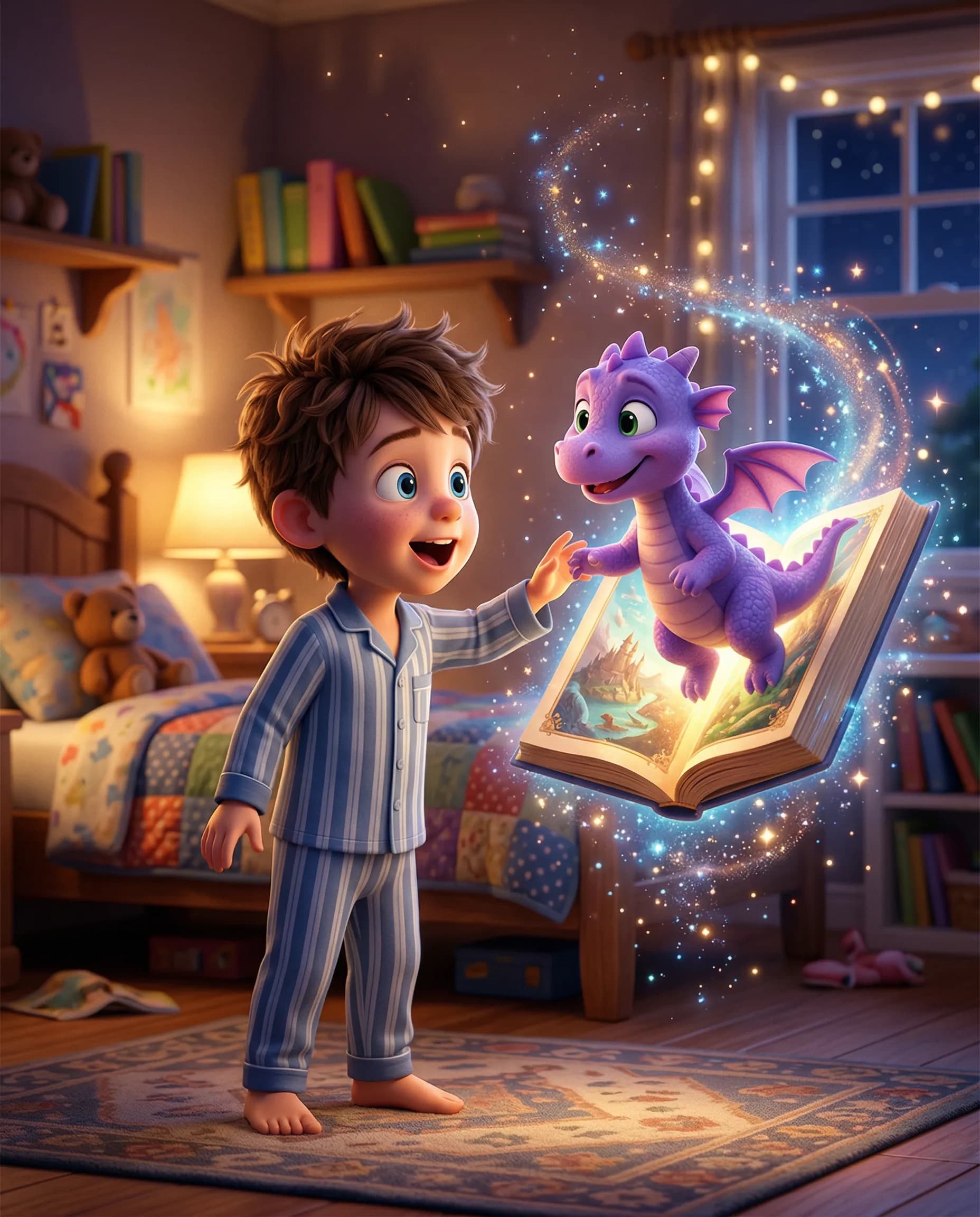
The Science Behind Why Kids Light Up When They Hear Their Name in a Story
Co-founder
Editorial standards: how we research and update articles
Watch a toddler's face when they hear their own name in a story. Their eyes go wide. They lean in. They point at themselves. It's one of those pure, unfiltered moments of joy that makes parenting worth all the sleepless nights.
But it's more than just cute. There's real neuroscience behind why children respond so powerfully to hearing their name in a narrative context — and the developmental benefits are significant. Understanding this science can help you harness one of the most effective tools available for building your child's confidence, emotional intelligence, and love of reading.
Your name is your brain's favorite word
A landmark study published in Brain Research found that hearing your own name activates unique regions of the brain that no other word triggers. Specifically, the medial prefrontal cortex and the superior temporal cortex light up — areas associated with self-identity and social processing.
For children, whose sense of self is still forming, this activation is even more pronounced. When a three-year-old hears "And then Luna discovered a magical garden," their brain doesn't just process the words. It constructs a vivid mental simulation where theyare the one discovering the garden. They aren't listening to a story. They're living it.
Researchers call this the cocktail party effect— the well-documented phenomenon where your brain can pick your name out of a noisy room, even when you're not paying attention. In children, this effect is amplified because their name is one of the first words they learn to recognize. It's deeply wired into their auditory processing. So when a bedtime story opens with their name, the child's brain doesn't just register it — it locks in, priming them for deeper engagement with everything that follows.
The confidence connection
When children repeatedly experience themselves as the hero of a story — someone brave, kind, curious, and capable — it shapes their self-concept. Child psychologists call this narrative identity: the story we tell ourselves about who we are.
A 2022 study in Developmental Psychology found that children who regularly heard personalized stories showed:
- Higher self-esteem scores
- Greater willingness to try new things
- Stronger empathy for others
- Better emotional vocabulary
Think about it from the child's perspective. Every night, they hear a story where they're the main character — where the real things they did that day become the foundation of a magical adventure. The implicit message is: your life is interesting, your experiences matter, and you are the hero of your own story.
This is especially powerful for children going through transitions — starting preschool, adjusting to a new sibling, moving to a new home. During uncertain times, hearing a story where they successfully navigate challenges (even fantastical ones) reinforces the belief that they can handle what life throws at them. It's not just a story. It's a rehearsal for resilience.
Name personalization vs. true personalization
Not all "personalized" stories are created equal, and the distinction matters. There are broadly two categories:
Name-only personalizationis what most personalized children's books offer. You enter your child's name, maybe their hair color, and it gets inserted into a pre-written template. "And then [CHILD NAME] found a treasure chest." These are charming as a one-time novelty — a birthday gift from grandma, a holiday keepsake. But the magic fades quickly because the story is the same every time. The child is named in the story, but they're not really in it.
Experience-based personalizationis what happens when the story is built around the child's actual day — the places they went, the things they did, the people they saw. This is the kind of personalization that research links to emotional development and better sleep. The child doesn't just see their name on a page. They recognize their life in the narrative, which triggers a much deeper level of engagement and emotional processing.
Night Night uses experience-based personalization. Every story is generated fresh from the details you provide about your child's day, which means your child never hears the same story twice — and every story feels genuinely theirs.
Why daily activities make the best stories
Generic personalized books (the kind where you type in a name and it gets slotted into a pre-written template) are a nice novelty, but they miss the most powerful ingredient: the child's actual experiences.
When a bedtime story mentions the ducks at the park, or the tower of blocks that fell over, or the funny thing grandma said at lunch, it does something a generic story never can: it validates the child's lived experience.
This daily validation has compounding effects. Over weeks and months, the child builds a library of stories about their life — an archive of proof that their days are meaningful and their experiences are worth remembering.
There's also a cognitive benefit that often goes overlooked. When a child hears their real-world experience transformed into a fantasy narrative — the trip to the grocery store becomes a quest through an enchanted marketplace, the family dog becomes a loyal dragon companion — they're exercising analogical thinking. They're learning to see connections between the real world and imagined worlds, which is a foundational skill for creativity, problem-solving, and abstract reasoning. It's the same cognitive muscle that, years later, helps them understand metaphors in literature, draw parallels in history class, and think creatively in science.
The bedtime advantage
Personalized stories are wonderful at any time of day, but there's something uniquely powerful about hearing one at bedtime. Sleep researchers have found that the brain consolidates memories and emotional experiences during sleep — particularly during REM cycles. When a child falls asleep immediately after hearing a story about their own day, their brain is primed to process and integrate those experiences during the night.
This is why personalized bedtime stories do more than just help kids fall asleep (though they absolutely do that — read our post on how personalized stories help kids fall asleep faster for the full breakdown). They also help children emotionally process their day, consolidate positive memories, and wake up feeling secure. It's one of the reasons pediatric sleep experts recommend ending the day with calm, positive reflection — and a personalized story is the most engaging way to do that for a young child.
How Night Night makes this effortless
When we had Noelle, I started making up bedtime stories about her day. She loved them. But I'm an engineer, not a storyteller — by the third night I was recycling plots and running out of steam.
That's why I built Night Night. Every evening, you spend 30 seconds telling Night Night a few things your child did today. You pick a theme (pirates, fairy tales, space, or something cozy). And Night Night generates a six-page illustrated storybook where your child is the hero, their real day is the plot, and the whole thing ends with them drifting peacefully to sleep.
It's the personalized storytelling experience that child development research recommends — without requiring you to be a creative writer after a 12-hour day. And because every story is saved to your library, your child can revisit their favorites anytime. We've seen kids ask to "read the one where I was a space pirate" weeks after it was created. Those stories become part of the family lore — cherished memories wrapped in magic.
The long game: building a love of reading
Here's the part that gets me most excited as a parent. Children who develop positive associations with stories — who see reading as something personal, exciting, and connected to their lives — become readers. Not because someone made them, but because stories feel like home.
The data backs this up. A longitudinal study by the Scholastic Kids and Family Reading Report found that children who were read to frequently before age six were significantly more likely to read for fun on their own by age nine. The strongest predictor wasn't how many books were in the home or how early the child learned to read — it was whether the child enjoyed being read to. Enjoyment was the key variable.
Personalized stories maximize that enjoyment because the child is invested from the very first sentence. They're not listening politely to someone else's story — they're on the edge of their seat because it's their story. That emotional engagement is what turns story time from an obligation into a highlight.
Every personalized bedtime story is a deposit into that emotional bank account. Over time, the child associates books with warmth, safety, and the magic of seeing their own life turned into an adventure.
Getting started
If you want to bring personalized storytelling into your bedtime routine, Night Night's free first storyis the easiest way to try it. You'll see your child's reaction in real time — the wide eyes, the pointing, the "That's me!" — and you'll understand why the science points so strongly in this direction.
Night Night also makes a wonderful gift for familieswith young children. Instead of another toy, give the gift of a year of personalized bedtime stories. It's the kind of present that becomes part of a family's nightly ritual — and that's a gift worth giving.
That's not just a bedtime hack. That's a foundation that lasts a lifetime. Explore our plans to find the right fit for your family.
Related reading
Try a personalized bedtime story tonight
Download the app free — every plan includes illustrations and voice narration.
Download on the App Store