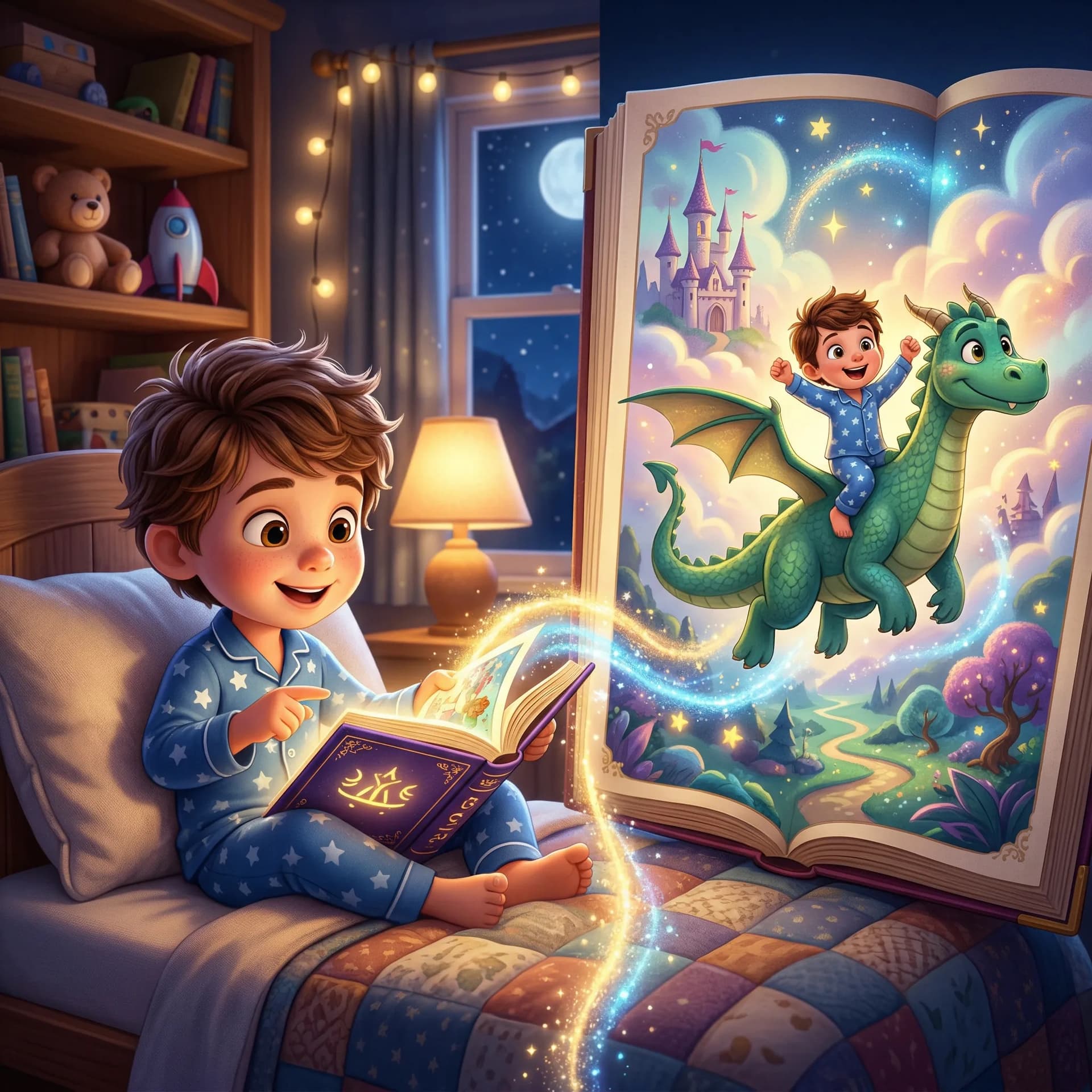
Why Personalized Bedtime Stories Help Kids Fall Asleep Faster
Co-founder
Editorial standards: how we research and update articles
Every parent knows the struggle: it's 7:30 PM, the bath is done, teeth are brushed, and now comes the hardest part — actually getting your child to wind down and fall asleep. You read a book, then another, then they want water, then one more story, and before you know it an hour has passed and nobody is sleeping.
But what if the story itself could do the heavy lifting? What if, instead of a generic tale, your child heard an adventure starring them — built from the real things they did that day? That simple shift — from generic to personal — turns bedtime from a battle into the best part of the day. And the science backs it up in ways that might surprise you.
Why personalization matters for sleep
Research from the University of Sussex found that just six minutes of reading reduces stress levels by up to 68% — more than listening to music or going for a walk. But not all reading is equal. Studies on children's engagement show that personalized content — stories that reference familiar people, places, and events — holds attention longer and produces stronger emotional responses.
When a child hears their own name and recognizes the park they visited that morning or the mac and cheese they ate for lunch, their brain doesn't just process a story. It relives the day in a safe, warm, magical context. This mental review of positive daily experiences is exactly what child psychologists recommend for reducing bedtime anxiety.
Think of it as a guided meditation designed specifically for your child. Adults use apps like Calm and Headspace to reflect on their day and ease into sleep. A personalized bedtime story does the same thing for children — except it's wrapped in magic, adventure, and the sound of a parent's voice (or a warm narrator voiceif you prefer). The familiarity of real events gives the child's mind something concrete to latch onto, while the fantastical elements let those memories gently blur into dreams.
The neuroscience of hearing your own name
There's a reason your child perks up the instant they hear their name in a story. A study published in Brain Research found that hearing your own name activates the medial prefrontal cortex and the superior temporal cortex — brain regions tied to self-identity and social processing. For young children whose sense of self is still developing, this activation is especially powerful. It pulls them into the narrative in a way that generic characters simply cannot. You can read more about this effect in our post on why kids love hearing their name in stories.
When your three-year-old hears "And then Mila flew over the rainbow bridge," their brain doesn't just decode the sentence — it builds a vivid mental simulation where they are the one flying. That level of immersion is calming, not stimulating, because the child feels safe inside the story. They are the hero, and the hero always ends up cozy in bed by the last page.
The problem with making it up on the spot
Most parents who try to tell personalized stories hit the same wall: it's exhausting. After a full day of work, meals, and wrangling, constructing a coherent, engaging, age-appropriate narrative from scratch every single night is a tall order.
- You run out of plot ideas by Wednesday
- The story meanders because you're making it up as you go
- You forget what they actually did that day
- Your energy is gone — and kids can tell
- Siblings want different stories, and you only have so much creativity left
We've heard from parents who tried journaling their child's day so they'd have material at bedtime. Others bought fill-in-the-blank story templates. Some downloaded generic story apps that insert a name but otherwise tell the same tale every night. None of these solutions capture what makes a truly personalized story special: a fresh, original narrative built around today's specific experiences, told in a way that feels magical rather than mechanical.
That's exactly why we built Night Night. You spend 30 seconds telling us a few things your child did today — pick a fun theme like pirates or fairy tales, and we generate a beautifully written, personalized bedtime story in seconds. Complete with illustrations and voice narration.
Personalized stories vs. traditional picture books
Let's be clear: we love picture books. Our shelves are full of them, and reading together is one of the most important things a parent can do. But traditional books and personalized stories serve different purposes at bedtime.
A picture book introduces your child to new worlds, characters, and vocabulary. It's wonderful for learning and bonding. But it doesn't reference your child's day, and after the third reading of the same book, the novelty factor drops. Personalized stories, on the other hand, are new every single night. They weave in the specific details of your child's life — the friend they played with, the sandwich they ate, the puddle they jumped in — and transform those moments into adventure. That sense of "this story is aboutme" is what makes a child relax and lean into sleep rather than asking for "one more book."
The ideal bedtime routine might include both: a picture book for learning and language, followed by a personalized Night Night story as the final, calming step before lights out. If you're looking for a framework, our guide to a 30-minute bedtime routine breaks it down step by step.
How it works in practice
Here's what a typical Night Night evening looks like in our house:
- Around 7 PM, I open Night Night and quickly type what Noelle did today: "We went to the farmer's market, she pet a goat, and we made cookies after lunch."
- I pick a theme — tonight it's "underwater" because she's been obsessed with octopuses.
- In about 10 seconds, a six-page illustrated story appears. Noelle is an underwater explorer who discovers a coral reef that smells like cookies, befriends a goat-fish at a submarine farmer's market, and drifts off to sleep in a seashell bed.
- We read it together, or let Charlotte (our favorite narrator voice) read it aloud while Noelle looks at the pictures.
She's usually asleep within 10 minutes. Not because we drugged the story — but because hearing her real day reflected back as a magical, safe adventure tells her brain: today was good, you're safe, it's time to rest.
What surprises most parents is how quickly children start to expecttheir personalized story. After a few nights, Noelle would remind us of things she did that day — "Don't forget the ladybug!" — because she knew those details would appear in her story. It became a way for her to process and reflect on her experiences, which is exactly the kind of metacognition that developmental psychologists encourage in early childhood.
The research behind bedtime stories and sleep quality
A 2023 study published in the Journal of Child Psychology and Psychiatry found that children with consistent bedtime story routines fell asleep 15 minutes faster and experienced fewer night wakings. The key factor wasn't the length of the story or even the content — it was consistency and emotional warmth.
Personalized stories score high on both. They're consistent because you do it every night (Night Night makes it effortless), and they're emotionally warm because they're literally about your child's life.
Additional research from the American Academy of Pediatrics highlights that bedtime reading is associated with better social-emotional adjustment in young children. Children who are read to regularly show fewer behavioral problems, stronger parent-child attachment, and greater emotional regulation. When those stories are personalized, the attachment benefit is amplified because the content itself reinforces the bond: "Mom or Dad knows what I did today, and they turned it into something magical just for me."
A gift that keeps giving
One of the things we hear most from Night Night families is how much children love revisiting their old stories. Every story is saved in your library, creating a growing collection of personalized adventures that doubles as a kind of magical diary. Parents tell us their kids scroll through past stories the way adults scroll through photo albums — "Remember when I was a space pirate who found a cookie planet?"
This also makes Night Night a wonderful gift for grandparents, aunts, and uncles who want to give something meaningful. Instead of another toy that ends up in a drawer, it's a year of personalized bedtime stories — a gift that becomes part of the family's nightly ritual.
Try it tonight
Night Night offers a 3-day free trial — with illustrations and voice narration included on every plan. It takes about 30 seconds to set up, and you'll have a personalized bedtime story ready before your child finishes brushing their teeth. Try free for 3 nights and see the difference a personalized story makes at bedtime.
If you're curious about the full science behind how bedtime routines affect sleep, check out our plansto see which one fits your family — or start a free trial and let your child's reaction speak for itself.
Related reading
Try a personalized bedtime story tonight
Download the app free — every plan includes illustrations and voice narration.
Download on the App Store