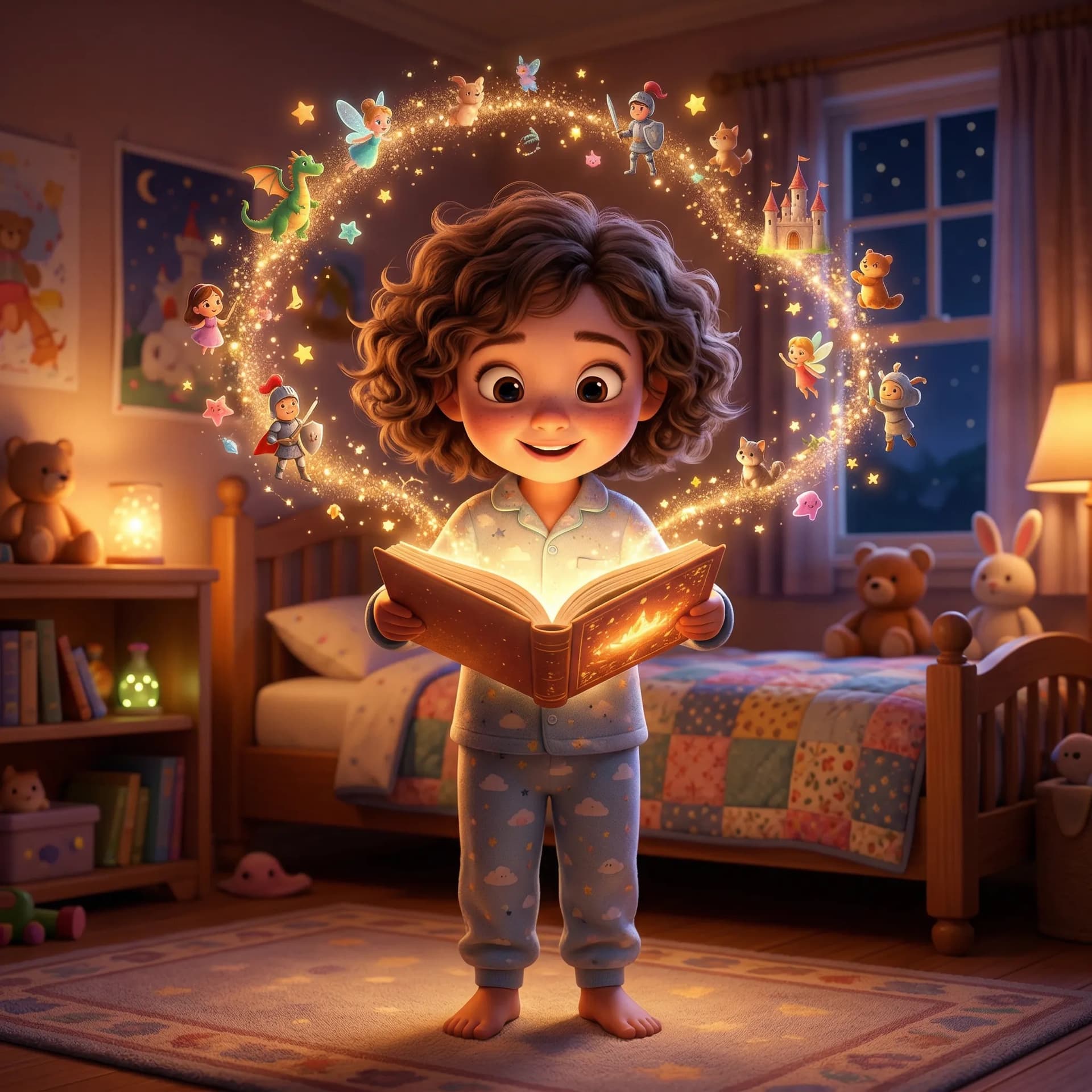
Why Kids Ask for the Same Story Every Night (And Why You Should Let Them)
Co-founder
Editorial standards: how we research and update articles
If you are reading the same book to your child for the fourth night in a row — the one with the bunny, or the trucks, or the page about the moon — you are not alone, and you are not doing anything wrong. You are, in fact, giving your child exactly what their brain needs at bedtime.
Repetition looks like stuckness from the outside. From the inside of a young brain, it is the opposite: repetition is how safety is built.
What repetition does for young brains
Between roughly ages two and six, children are doing enormous amounts of cognitive work: sorting the world into categories, learning what happens next, building models of how people and objects and stories behave. A familiar story is a closed system — the plot is known, the ending is known, the rhythm of the reading is known. That closed system is cognitively restful.
Developmental psychologists call this consolidation: the process by which a child's brain takes new information and settles it into long-term understanding. Hearing a story once is exposure. Hearing it four times in a row is consolidation. The child is not being lazy. They are working.
Why this matters at bedtime specifically
Bedtime is the hardest transition of the day for most young children. The world has been loud and novel and demanding. The bed is quiet. Moving from one state to the other requires letting go — which, for a small person with a big imagination, is genuinely difficult.
A familiar story is a bridge across that gap. Its predictability cues the body that nothing new is coming, that the day is safely closing, that it is okay to stop holding on.
This is the same reason adults listen to the same music when they're falling asleep, or rewatch the same comfort show when they're anxious. Novelty activates. Familiarity calms.
But what about the parent?
The research is clear that repetition is good for the child. The research is less clear about what happens to a parent reading the same page about the sleepy rabbit for the fiftieth time. We will not pretend this part is easy.
Here are a few strategies that help:
- Reframe it as mastery, not monotony.Your child is doing cognitive work. You are the scaffolding. This is a short window in your child's life.
- Rotate the same-ness.Have three "favorite" books in the rotation, not one. Each one can still be heard four times a week without driving you under.
- Use a different voice. Try the story in a whisper. Try it sped up. Try it with the bunny speaking in a grandpa voice. Kids usually laugh, which breaks the monotony without breaking the familiarity.
- Use personalized stories as the new familiar. This is what we built Night Night for. A personalized story is new every night and familiar, because the hero is always your child. Same name. Same sidekick. Different adventure.
The personalized-story middle path
The traditional tradeoff at bedtime is: same story (safe, boring) vs. new story (stimulating, unpredictable). Both have costs.
A personalized bedtime story threads the needle. The hero is always your child — same name, same pet, same storybook face — but the plot, setting, and world change every night. The familiarity is where your kid needs it (the hero) and the novelty is where their attention wants it (the adventure).
For kids who are locked onto one specific book, you can also let them bring the book's characters into the Night Night story as their Sidekick™ — the same bunny or truck can travel through every adventure, which honors their attachment without requiring you to read the same words again.
When repetition becomes rigidity
For most kids, the "same story, always" phase passes somewhere between ages four and six. If it's lasting longer, or becoming extremely rigid (the child distresses at any deviation), that's a different conversation worth having with a pediatrician. Most of the time, though, repetition is just the normal cognitive work of a small person building their model of the world.
Try it tonight
If you want a new story every night that still feels familiar to your kid, start a story tonight— type your child's name, pick a world, and read their first full story free.
Related reading
Try a personalized bedtime story tonight
Download the app free — every plan includes illustrations and voice narration.
Download on the App Store